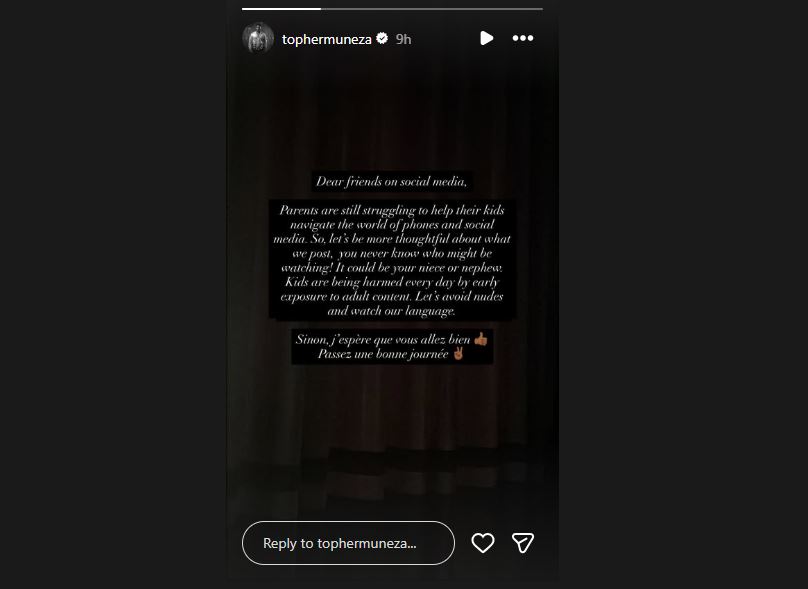

Through his Instagram account, Rwandan music star Christopher Muneza raised an important concern about parents struggling to guide their children on responsible phone and social media use. He highlighted the potential harm children face due to negative content they encounter online.
On Tuesday, November 11, 2025, Christopher emphasized, "Parents are still trying to help their children understand how to behave in a world dominated by phones and social media. Therefore, let's avoid posting everything on these platforms without thinking, as we don't know who it might reach. It could be your sibling's child or someone else's."
The artist further explained the alarming trend of young children being exposed to inappropriate or adult content on social media, calling for social media users to be more mindful.
In his heartfelt plea, Christopher added, "Children's lives are being damaged daily because they are exposed to adult content too early. Let us not post explicit photos and let us also be mindful of the language we use."
Concluding his message, Christopher shared a cheerful greeting, stating, "I hope you're all doing well. I wish you a wonderful day."
Christopher’s message resonated deeply with his followers. Many fans praised him for taking a stand and reminding adults of their pivotal role in protecting and educating children about safe online practices.
His advocacy underscores his influence not only as an entertainer but also as a voice inspiring a responsible and value-driven society.
### Rising Concerns Over Social Media Misuse
Christopher delivered his remarks amid heightened discussions on social media, triggered by reports of explicit private videos being circulated online. A recent case involved a leaked video of artist Yampano, which raised significant public concern in Rwanda.
The misuse of social platforms to distribute private or explicit content is, however, not unique to Rwanda. Globally, numerous celebrities have suffered similar invasions of privacy, with such incidents stemming from hacking, impersonation, or negligence. Here are a few notable examples:
- Jennifer Lawrence: In 2014, "The Fappening" scandal made headlines after her private photos, along with those of other celebrities, were leaked due to an iCloud hacking incident. She described the experience as traumatic and a gross violation of privacy.
- Kim Kardashian: Kim's intimate video with Ray J was leaked online. Although it initially impacted her negatively, she turned the situation into an opportunity to grow her brand.
- Rihanna: The global star fell victim to the leakage of nude photos, later expressing how this violated her personal rights significantly.
- Vanessa Hudgens: Nude photographs of this actress and singer made rounds in 2007, leading her to publicly apologize. The scandal affected her rising career, especially her association with Disney.
- Chris Brown: A personal connection of his shared explicit photos of Chris in 2011, which led to public embarrassment.
- Iggy Azalea: After unauthorized images of her surfaced online, the Australian rapper strongly condemned the invasion of her privacy.
- Bella Thorne: In 2019, she made the bold decision to release her intimate photos herself after a hacker threatened to leak them, reclaiming power over her narrative and protecting her mental health.
These examples highlight how even well-known personalities are vulnerable to the consequences of internet abuse. Many of these celebrities have since advocated for privacy protection and responsible online behavior.
### The Lasting Effects on Children
Several research studies have documented the detrimental impact of harmful online content on children. According to findings from the American Psychological Association (APA), exposure to explicit material at a young age shapes negative behaviors. Children are more likely to engage in sex early, view it as casual, and struggle with self-control as they age.
Similarly, a 2021 study by Harvard University revealed that repeated exposure to explicit images or videos can cause low self-esteem, social anxiety, and shame. Girls, in particular, were found to compare their physical appearance to unrealistic body standards portrayed online, leading to issues in their social and academic lives.
UNICEF has also warned that children exposed to explicit content become easy targets for online predators. Furthermore, Common Sense Media's 2022 research stressed the importance of parental guidance. It showed that children who are not educated about internet safety are at higher risk of stumbling into harmful digital spaces.
Stanford University’s research on over 1,500 high school students further proved that exposure to pornography increases instant gratification behaviors, undermines patience, and negatively affects focus on studies.

### Christopher’s Call to Action
Rwandan artist Christopher Muneza urged social media users to take responsibility for the content they share, reminding them it may reach children. He emphasized the importance of avoiding explicit content and offensive language on these platforms.