
But I see it differently. To me, Monday is not simply the beginning of another week; it is the beginning of new commitments, responsibilities, opportunities to serve, deliver, and make an impact. There would be no ending without a beginning.
We often celebrate the weekend and enjoy the fruits of our efforts while forgetting to appreciate the source. The ordinary days, difficult moments, and sacrifices that make those fruits possible.
I believe we would never fully appreciate the sweetness of love if we had never tasted the bitterness of hatred. Light would have little meaning without darkness.
In fact, sometimes the most beautiful view is the one we discover at night, when light shines through the darkness. There are no solutions without problems, and there are no graduations without enrolment, studying, testing, examinations, and showing up every day. So, Monday is not a bad day; it is simply part of the journey towards Friday and Sunday.
I understood this differently on one particular Monday. I had been feeling unwell for several days, but that morning I woke up motivated. I arrived at work on time, dressed well and ready to serve. I convinced myself that whatever was wrong with my body could be overcome through what I ate, drank, and the sport I practiced.
So, I started working, trying to maintain my usual energy. But the truth was that my battery was almost empty. I told some colleagues that I was not feeling well. One of them helped me prepare a simple mixture of sugar, salt, and water, which I drank before continuing to work. By noon, however, my body could no longer keep going.
My heart was still pushing, but my body was giving up. “Man, if you die today, tomorrow won’t be a holiday. You have to stop playing the hero and go to the hospital,” one of my colleagues told me. The words struck me. I asked for permission to leave and went to the hospital, driving slowly because I was still trying to push my limits.
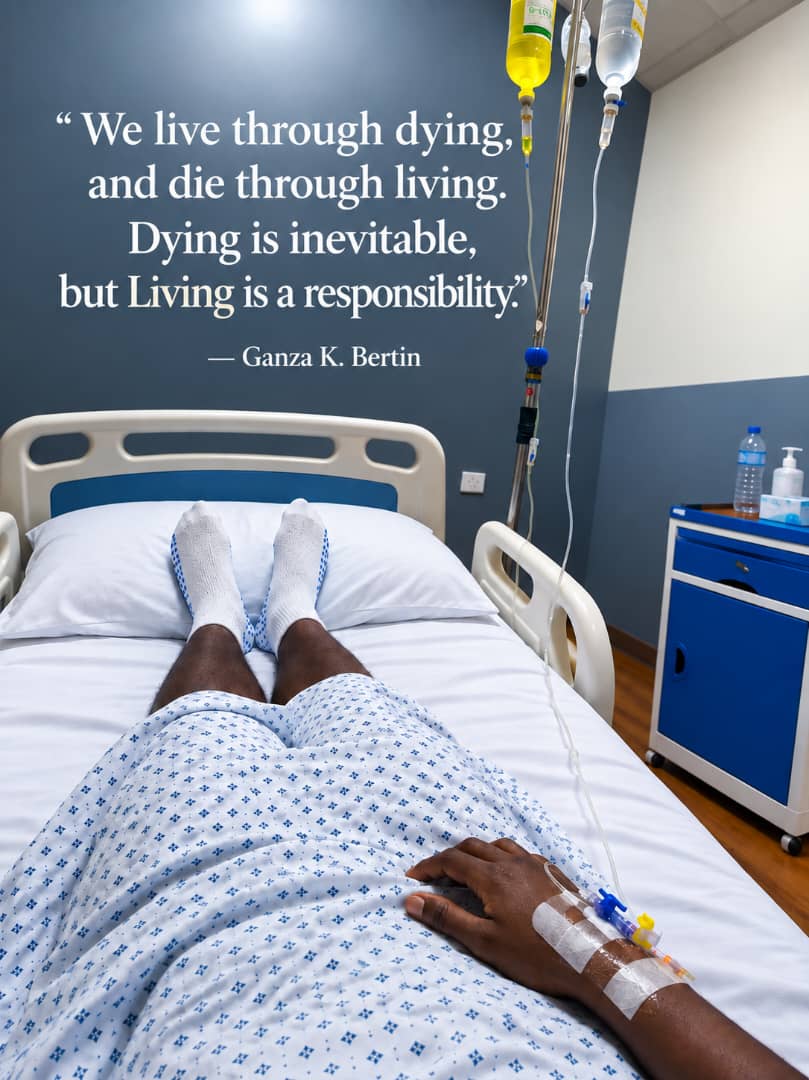
At the hospital, my case was handled urgently. I received treatment and medication, followed by further examinations. I remember refusing to sit in a wheelchair while changing rooms because I believed I still had enough strength. One of the nurses looked at me and said, “Sir, we see your condition. You are very sick and weak.
Please allow us to take care of you.” She explained that if I refused and something went wrong, they could even face consequences for failing to do what was necessary. That moment forced me to accept something I often struggle with: vulnerability. I surrendered and allowed others to take care of me.
The days I spent in the hospital became more than a period of treatment. They became a period of reflection. Not only about that Monday, but about life itself. Far away from the noise of the world, its routines, obligations, responsibilities, tasks, and constant struggle for survival, I had an opportunity to pause.
I watched life quietly, almost as though I was watching a movie, examining it from a distance and questioning what I had previously taken for granted. And that was when I realized something profound: if I had died in that hospital, it would not have been my first death. It would have been my final one.
Perhaps this sounds philosophical, but I believe philosophy is one of the foundations of life. It teaches us to stop, question, and examine the meaning behind our existence.
I realized that life and death exist in parallel. They happen simultaneously. The moment we begin living is also the moment we begin dying. And the moment we stop dying is also the moment we stop living.
This is what we eventually call physical death. Every day we live, something in us is also being spent. As we work, build careers, earn money, serve others and pursue our dreams, a part of us is consumed. It may be our physical strength, energy, mental capacity, emotional resilience, or, perhaps most importantly, our time. Time is life.
Every time we serve, support, teach, create, or add value to someone or something, we give a part of ourselves. Sometimes the cost is tangible; sometimes intangible. During my stay in the hospital, I saw this clearly. Doctors and nurses gave their knowledge, energy, and time to keep me alive.
My colleagues and friends visited me, supported me, and covered for me at work. In helping me, they were also giving away pieces of their own lives for my benefit. It reminded me of Paulo Coelho’s famous words in The Alchemist: “When you want something, all the universe conspires in helping you to achieve it.”.
I felt surrounded by people whose care, time, knowledge and love became part of my recovery.But this article is not really about my hospital experience. It is about what the experience gave me: a break from routine and an opportunity to see life differently. My illness was a moment of physical vulnerability, but it became an opportunity for mental renewal and a restoration of perspective.
So, as you read this, allow me to remind you of something simple: live. Find your meaning of life. Define what success, fulfilment, and a good life mean to you. Then go out there and live intentionally, responsibly and meaningfully. You cannot do this life alone. You need others, just as others need you.
Learn to give and receive, to serve and be served, to support and be supported. Because as the wiseman Morrie said: “When you learn how to die, you know how to live”. Death is inevitable. We die every day, whether we want to or not. But life is a responsibility.
So, live responsibly, use your time wisely, love deeply, serve generously, and create courageously. Because by doing this, you are not only living, but also helping others to live. Because they are all dying anyway. And so are you.